Wednesday, 15 September 2010

Monday, 16 August 2010
Reading the "History of the Romish Literature" of Manfred Fuhrmann (Part I)
1) the Latin language: only the idiom of the region Latium, but together with the Idea of the State the Romish idiom became the normative language for the west part of the Roman Empire, especially for Iberia, North Africa, the region around the Black See. The Rumanian language of today is developed from Latin. The development of the Latin language to its classic form as a normative language of the Empire includes the "Rhotacism" ('s' between vocals is substituted by 'r'); the disappearance of Diphthongs; the three verbal forms of the Indo-German language family, which survive in Greek, were reduced: the aorists were reduced to the present and perfect forms; the grammar became more strict.
2) the begin of the Romish literature: 240 before Christus with the translation of Greek comedies and tragedies. Greeks began to settle down in Italy and had a large influence on the Etruscan culture. The Romans didn't have their own myths and thus the Greek literature must have had also an influence on the development of the Roman religion. Also the Lex XII tabularum was the result of the influence of Greek culture. The Romish religion is more abstract, the gods were identified with their power and acts, while the Greek religion is more anthropomorphic. The symbols of the power: faces, lictores and the sella curulis go back to the Etruscan influence. Livius wrote about the Etruscan people: "Gens ante omnes alias eo magis dedita religionibus, quod excelleret arte colendi eas". The fights of the gladiators also go back to Etruscan customs. Before the direct influence of the Greeks the Romans didn't know the difference between proses and poetry. They used rhythmic lines in the proses, and called text written in such a way "Carmen". One kind of verses was known: versus Saturnius (allusion of the Golden age), which was used by Livius Andronicus and Naevius. But Ennius substituted it through the Greek hexameter. Two examples of the Versus Saturnius: "Adesto, Tiberine, cum tuis undis" (a prayer) and "Virum mihi, Camena insece versutum" (the translation of "Odysseus" by Livius Andronicus). Other kinds of literature: nenia, accompanied by flute, lamentation of the dead; heroic songs, sung at the meal, and harvest songs. Besides these one can also find the Fabula Atellana, the Laudatio Funebris (a specific Roman genre), and the Annales.
3) the development of the Romish Literature after the muster of the Greek literature: ludi Romani - ludi scaenici (theatre plays). The school system of the Greeks: all children could learn gymnastics, music, writing, reading and calculating. Children from better families could go later to school to learn literature, grammar and stile. Later, a small number of privileged young men could learn rhetoric. The Romans copied this kind of school system. The Roman schools were private, while the theatre plays were organised by the State. Not only in these two domains did the Greek culture influence the Roman culture, but also regarding the Roman customs.
(To be continued)
Friday, 13 August 2010
The Death as Cynic - Johannes von Tepl's "The Ploughman and the Death"
It is a short dialogue between a Ploughman, who ploughed with feather (that means he was not a peasant, but a clerk) written in Middle High German. The ploughman laments the early death of his wife Margaretha, whom he loves dearly, and accused the Death of injustice. The Death answers in plural form "We", like God do in the second last chapter of this dialogue. The Death attests that the wife of the ploughman has been a very virtuous woman, but refuses to acknowledge the injustice down to the ploughman. As everyone who is once born must die, disregarding with what age and who. The ploughman lists the virtues and great deeds of man, but the Death laughs at the folly of man. The ploughman praises the luck of family life, the Death numbers all the disadvantages of a married life. The ploughman sings a hymn of beautiful and virtuous women, the Death sneers and plays the role of the worst misogynist. The ploughman asks sincerely for advices to make amend of sorry, the Death stresses the uselessness of all hope to find remedy for the loss. In the end God comes to settle the quarrel, and tells the Death to be humble as the power of Death comes only from God. The ploughman is praised for his courage but is also asked to rest the case, because, as God is written as saying: "Every human being is obliged to give the Death his life, the Earth his body, and Us his soul" (chapter 33). Thus, the ploughman calms down and prays for the soul of his wife. The last chapter (34) consists in a very long and moving prayers which assembles a litany, in which the ploughman addresses God in all his attributes as the Creator and Lord of our life and existence.
But I don't quite see which function the quarrel can have: the Death appears in the role of a cynic. Life is nothing than sorrow and hardship, human beings are bad, hope and joy make only the loss of what is dear to us more painful. The human body is nothing than a cadaver, given over to the worms. The ploughman is in comparison a lover of the mankind and tries his best to defend the value of life and dignity of man, because, as he stresses on many places, man is the creature of God so can't be as bad and unworthy as the Death sees him. But neither party lets himself be convinced by only one point of his opponent. So it is a riddle to me what the point of this dialogue is. Perhaps the writer only wants to show the unreconcilable antithesis of the human existence: Life and Death, Joy and Sorrow. Without the Christian Faith it will ends in an aporia. Without the Christian Faith we will go back to the hopeless melancholy of Horace, whose only advices to overcome this antithesis is to carpe diem, and drown your sorrow in the drunkenness. While the Death in this dialogue tells one, despite all his sneers, to "avoid the evil and do what is good, to search for the peace and to keep it constantly. And one should not overestimate the earthly joy and possessions. Above all, one should have a pure conscious". So the Death as cynic is not a hedonist nor a nihilist. He is a curing cynic like the cynics in Lucian's Satire: the cynic is there to keep people honest and to free their soul from foul spots and superfluous sorrow and conceitedness.
One chapter (chapter 16) where the Death describes himself is especially interesting, which I translate as in the following:
"You ask, what we are: We are nothing and are nevertheless something. We are nothing, because we have no life nor substance, no figure nor duration (unterstand: not quite sure what meaning this word in Mhd. has). We are again something, because we are the End of Life, the End of the Existence, the Begin of Nothing, a thing between both of them. [...]".
Thursday, 12 August 2010
De vera Religione - Part I: Plato and Christianity
Yesterday in a hurry I bought the "De vera religione" for the train trip, didn't read it much though. Today I read Chapter I to VII. To be noted is the description of Plato as a crypt Christian. The search of Plato after the stable, never changing beauty is taken by Augustine as the search after God. The similitude between Plato's thinking and the Christian teaching consists according to Augustine in the followings: 1) the truth should be seen through the mind, not through eyes (non corporeis oculis sed pura mente veritatem videri), and that to adhere to this truth is the perfect luck, and that to achieve this one must live an ascetic life without the distortion and delusion which are brought up by the lusts; 2) to see the unchanging beauty, the soul must be healthy (sana); 3) among all creatures only the rational and intellectual soul is able to see the eternity of God and to enjoy the eternal life. But Augustine opines that Plato was afraid to act against the conventions of his society and thus didn't give up a life in the world and to seek God in a life style whilst all the secular interests were left behind. In comparison, the Christians achieved what Plato originally intended to.
From Chapter V to VII Augustine writes that the True Religion is only in the Catholic Church. His definition of what is catholic is quite interesting: that is the community which is free from heresy and schism (which comes up due to the arrogance). Although people can have the same liturgy, but the difference in belief can excommunicate one from the catholic community. And it is possible, thus Augustine, that very orthodox and pious people can be excommunicated through mistake. But a true saint will endure all this injustice and will never start an act of disobedience (nr. 33: "quam contumeliam vel iniuriam suam cum patientissime pro ecclessiae pace tulerint neque ullas novitates vel schismatis vel heresis moliti fuerint, docebunt homines quam vero affectu et quanta sinceritate caritatis deo serviendum sit").
To be continued.
Sunday, 8 August 2010
Death in Life (Horace's Carmen 1, 4)
The motif of the famous "Carpe Diem" (1, 11) poem of Horace can also be found in his Carmen 1, 4, where he wrote in the first three verses about the Joy of Spring. But in the first line of the fourth verse the word "Death" appeared: pallida Mors aequo pulsat pede pauperum tabernas regumque turris. And he mentioned also that we should not make plan and have expectations for times long after: o beate Sesti, vitae summa brevis spem nos vetat incohare longam; iam te premet nox fabulaeque Manes.
to: Manes see the tombstone below

written in Archilochium tertium.
But why! Is it common for the ancient literature? This melancholy. I don't think so. Horace seems to be too sentimental for an ancient poet. No unreflected serenity which is supposed to be so characteristic for the ancient world. Always with the antithesis of Life and Death, oh the Death triumphs in the end! But for my taste, this reflection is again too shallow. It is without the metaphysical depth of the baroque poetry, without the heroic attitude of a baroque man.
And does it move me, this poem? Not so much like that of his Carmen 1, 11. Why? Because it is only about the shortness of one's own life - though he talks to Sestius, but he just means the pleasure of one's life is so transient. In comparison, Carmen 1, 11 talks about the shortness of the time two friends (lovers) can be together. And only the latter pains me. Not only Death can part two, oh lucky is she who parts from her friend only through Death. To part while still in life is a greater pain! And do I fear Death? I don't. But people say I only say I fear Death not because I am still young. Perhaps they are right.
Wednesday, 4 August 2010
Die Oratio Dominica (Chapter 5 of "Jesus of Nazareth"
Recapitulation of chapter 4: the Sermon on the Mountain tells us how to be a human being. And a real anthropology is only possible in the light of a theology.
1) Then Pope Benedict turns to the version of Oratio Dominica in the Matthew's Gospel: the evangelist tells us how to pray in a right way. Not the human being should be in the centre of the prayer, but only the love to God. As the Revelation says, God calls everyone with his own name, which nobody knows other than God (Rev. 2, 17). The Oratio Dominica is a We-Prayer, that means, only in the Church we can reach God as individuals! So in a correct prayer one should brings one's innermost personality to God but at the same time in a community. The other false way to pray is the thoughtless repetition, as we are told by the evangelist.
In the prayer we intensify our relationship to God. But not only the awareness of being together with God is needed, but also concretes formulas of prayers. The prayers of Israel and later the prayers of the Church are the school of praying and also lead to a deep transformation of our life.
Saint Benedict wrote in his Regula: Mens nostra concordet voci nostrae (cf. also Reg 19, 7). But in the prayers of psalms and the prayers in the liturgy of the Church it is different: our mind must be obedient to the Word, in this Word God comes to help us to pray and find Him.
2) the version of Luke's Gospel: the Father-Son-relationship in the Oratio Dominica. The inner unity with God.
3) Structure of the Oratio Dominica:
Our Father:
three petitions with "thou", and 7 with "we", thus its structure is parallel to Decalogue. As we only know the Father through the Son, so the prayer begins with the addressing of God as "Father". And God is our Father, because our life comes from Him as the Creator and belongs to Him. To be children of God is to be the followers of Christ. But only Jesus Christ can say: "my Father", but we all must say "our Father".
Who art in heaven:
Name of God: I am who I am (Ex 3,6).
Thy Kingdom come:
The Kingdom of God comes over a pure heart, and this is what we pray for.
Thy will be done on earth as it is in heaven:
Jesus Christ is the heaven, and God's will is done in Heaven. We on the earth should follow Christ in obedience, so that we can come nearer to heaven.
Give us this day our daily bread:
As Cyprian already said, we pray for OUR daily bread, no one should pray for his own alone. And he said also, that who he must pray for the bread of today, is poor, so the followers of Christ are poor because they give up their property for God's sake. And the others, who haven't went so far, should stay in solidarity with these who try to love God in such a radical way (the religious). And of course already explained by the Fathers of the Church as the prayer for Eucharist.
and forgive us our trespasses as we forgive those who trespass against us:
This is a christological prayer, not merely a moral appeal, because the forgiveness of our Sins costed our Lord the Blood of His Son.
And lead us not into temptation:
Parallel to Hiob: not that God will tempt us into sin, but that he will send us trial, which we withstand ad gloriam Dei. But we pray at the same time, that God never let us alone in our trial.
but deliver us from evil:
with this prayer we pray for the Kingdom of God. And that is why in the Liturgy after the Pater noster the Priest prays further: Libera nos, quaesumus, Domine, ab omnibus malis, praeteritis, praesentibus, et futuris, et intercedente beata et gloriosa semper Virgine Dei Genitrice Maria, cum beatis Apostolis tuis Petro et Paulo, atque Andrea, et omnibus Sanctis, da propitius pacem in diebus nostris, ut ope misericordiae tuae adjuti, et a peccato simus semper liberi, et ab omni perturbatione securi. Per eumdem Dominum nostrum Jesum Christum Filium tuum. Qui tecum vivit et regnat in unitate Spiritus Sancti Deus. Per omnia saecula saeculorum. This Embolism, thus Pope Benedict, shows the human side of the Church, which is very much in need of deliverance.
Saturday, 31 July 2010
The Sermon on the Mountain (reading the Jesus Book of Pope Benedict - First Volume)
(Chapter 4) The Sermon on the Mountain is a passage which is often misused by the modernists to show that nothing is needed to achieve the salvation, no study, no observation of the laws, only a simple mind suffices. And liberal theologians tend to see this sermon as an abolishment of the Old Law, including the Decalogue.
Pope Benedict shows us that not an iota of the Old Law can be abolished, and tells us what the real meaning of this passage is. What is striking for me is how Pope Benedict shows the continuity between the Sermon on the Mountain and the Old Testament, especially the Psalms. It is also very interesting that he mentions on many places his good friend Rabbi Neusner. Thus, the liberal thesis that the Sermon on the Mountain presents a new Ethics and abolish the old Ethics of OT is refuted. And with "the poor" mentioned in the sermon are not meant impoverished people, as poverty doesn't lead to salvation, but those who are poor before God, that is, those, who don't boast of what they have done. The Holy Father cites a sentence of Therese of Lisieux: "I will stand before God with empty hands and keep them open". It means, we open our hands to receive the Grace of the Lord. The poor are also those who decide to abandon earthly comfort to follow the example of Christ, like Francis of Assisi did.
The Sermon on the Mountain, thus Pope Benedict, is a hidden Christology: as God took the flesh of man and died for our sake. So the Sermon on the Mountain tells us how to be the true imitator of Christ: to love, and that means to abandon every kind of egoism. And Pope Benedict wrote: "in opposite to the alluring glamour of Nietzsche's picture of man this way (of imitation Christi) appears poor, but it is the real way of life to ascend, only on the way of love the richness of life and the magnitude of human vocation become available".
In the second part of this chapter Pope Benedict tells us that according to the Jewish Tradition, the Messiah is supposed to bring his own "Torah". So the question is raised again: do the new laws substitute the old ones? The answer of Pope Benedict is: they don't abolish the old laws, but fulfil them. A very interesting passage which our Pope quotes from the book of Rabbi Neusner is: Jesus has, in comparison to the prophets, not a single new law! Jesus said only, come and follow me (Mt. 19, 20). And that is the reason why Rabbi Neusner decides that he remains in the Jewish Religion, because Rabbi Neusner finds that to follow Jesus will be contrary to the first (to honour God alone and to keep Sabbath) and the fourth (to honour father and mother) commandment. Pope Benedict shows that these commandments are fulfilled in the social teachings of the Church. And Pope Benedict shows also that in the Torah Israel is not only for its own people there, but is to become the light of all people in the world. The aim of the Holy Father is, as I see it, to show that Jesus Christ stands in the continuity with the OT, though he brought very new and revolutionary teachings. But his teachings can also be found in the inner structure of the Torah.
This approach of our Holy Father to the NT is very interesting. It is not only in the hermeneutic tradition of the analogical reading, but also in a new sense as he is using the Jewish Tradition of Bible reading to support our Christian teachings. It will not only teach us to have more respect and insight for the Jewish Tradition which is in part also ours, but can also be useful to explain to the Jews what Christianity is, and even persuade some of them more easily, as the Scripture is central for the Jewish Religion.
Monday, 19 July 2010
The Reception of Homer in the Caroligian Renaissance?
I know that Homer was not read during the most time of the medium aevum. Greek was seldom studied. And as far as I know, there were no translations of Homer's Iliad and Odysseus. But it astonishes me to read that during the Carolingian Renaissance students were to read Homer. Well, at that time, Greek was still studied. Even Hincmar of Reims translated the Pseudo-Dionysius as well as John Scottus Eriugena. But still one expects little that they did read Homer. Did they learn from Homer's works through a second hand source, or was Homer read in original? This question I still have to pursuit. But it astonishes one not little when one reads from the classic allusions in a Latin poem by Eriugena (very long, typed according to the MGH edition, there nr. 2). But it doesn't show that he did read Homer himself. This poems goes on very quickly to the praise of the Cross and Christus. Eriugena wants to show that the Christian Reign is more glorious than the ancient reigns:
Hellinus Troasque suos cantarat Homerus,
Romuleum prolem finxerat ipse Maro;
At nos caeligenum regis pia facta canamus.
Continuo cursu quem canit orbis ovans.
Illis Iliacas flammas subitasque ruinas
Eroumque Machas dicere ludus erat;
Ast nobis Christum devicto principe mundi
Sanguine perfusum psallere dulce sonat.
Illi composito falso sub imagine veri
Fallere condocti versibus Arcadicis;
Nobis virtutem patris veramque sophiam
Ymnizare licet laudibus eximiis.
Moysarum cantus, ludos satyrasque loquaces
Ipsis usus erat plaudere per populos:
Dicta prophetarum nobis modulamine pulchro
Consona procedunt cordibus ore fide.
Nunc igitur Christi videamus summa tropea
Ac nostrae mentis sidera perspicua.
Ecce crucis lignum quadratum continet orbem.
In quo pendebat sponte sua dominus
Et verbum patris dignatum sumere carnem
In quo pro nobis hostia grata fuit.
Aspice confossas palmas humerosque pedesque,
Spinarum serto tempora cincta fero.
In medio lateris reserato fonte salutis
Ves haustus, sanguis et unda, fluut.
Unda lavat totum veteri peccamine mundum,
Sanguis mortales nos facit esse deos.
Binos adde reos pendentes arbore bina:
Par fuerat meritum, gratia dispar erit.
Unus cum Christo paradisi limina vidit.
Alter sulphureae mersus in ima stygis.
Eclypsis solis, lunae redeuntis Eoo
Insolito cursu sideris umbra fuit;
Commoto centro tremulantia saxa dehiscunt:
Rupta cortina sancta patent populis.
Interea laetus solus subit infera Christus.
Committens tumulo membra sepulta novo.
Oplistês fortis reseravit claustra profundi;
Hostem percutiens vasa recpta tulit
Humanumque genus nolens in morte perire
Eripuit totum faucibus ex Erebi.
Te Christum colimus caeli terraque potentem:
Namque tibi soli flectitur omne genu.
Qui tantum, largire, vides quod rite rogaris
Et quod non recte rite negare soles:
Da nostro regi Karolo sua regna tenere,
Quae tu donasti partibus almigenis.
Fonte tuo manant ditantia regua per orbem:
Quod tu non dederis, quid habet ulla caro?
Indiviam miseram fratrum saevumque furorem
Digneris pacto mollificare pio.
At ne disturbent luctantia fraude maligna,
Aufer de vita semina nequitiae.
Hostiles animos paganaque rostra repellens
Da pacem populo, qui tua iura colit.
Nunc reditum Karoli celebramus carmine grato;
Post multos gemitus gaudia nostra nitent.
Qui laeti fuerant quaerentes extera regna,
Alas arripiunt, quas dedit ipsa fuga.
Atque pavor validus titubantia pectora turbans
Compellit Karolo territa dorsa dare.
Heheu quam turpis confundit corda cupido
Expulso Christo sedibus ex propriis.
O utinam, Hluduwice, tuis pax esset in oris,
Quas tibi distribuit qui regit omne simul.
Quid superare velis fratrem? Quid pellere regno?
Numquid non simili stemmate progeniti?
Cur sic conaris divinas solvere leges?
Ingratusque tuis cur aliena petis?
Quid tibi baptismus, quid sancta sollempnia missae
Occultis semper nutibus insinuant?
Numquid non praecetpa simul fraterna tenere,
Viribus ac totis vivere corde pio?
Ausculta pavidus, quid clamat summa sophia,
Quae nullum fallit dogmata vera docens:
'Si tibi molestum nolis aliunde venire,
Nullum praesumas laedere parte tua'.
Christe, tuis famulis caelestis praemia vitae
Praesta; versificos tute tuere tuos.
Poscenti domino servus sua debita solvit,
Mercedem servi sed videat dominus.
Hellinus Troasque suos cantarat Homerus,
Romuleum prolem finxerat ipse Maro;
At nos caeligenum regis pia facta canamus.
Continuo cursu quem canit orbis ovans.
Illis Iliacas flammas subitasque ruinas
Eroumque Machas dicere ludus erat;
Ast nobis Christum devicto principe mundi
Sanguine perfusum psallere dulce sonat.
Illi composito falso sub imagine veri
Fallere condocti versibus Arcadicis;
Nobis virtutem patris veramque sophiam
Ymnizare licet laudibus eximiis.
Moysarum cantus, ludos satyrasque loquaces
Ipsis usus erat plaudere per populos:
Dicta prophetarum nobis modulamine pulchro
Consona procedunt cordibus ore fide.
Nunc igitur Christi videamus summa tropea
Ac nostrae mentis sidera perspicua.
Ecce crucis lignum quadratum continet orbem.
In quo pendebat sponte sua dominus
Et verbum patris dignatum sumere carnem
In quo pro nobis hostia grata fuit.
Aspice confossas palmas humerosque pedesque,
Spinarum serto tempora cincta fero.
In medio lateris reserato fonte salutis
V
Unda lavat totum veteri peccamine mundum,
Sanguis mortales nos facit esse deos.
Binos adde reos pendentes arbore bina:
Par fuerat meritum, gratia dispar erit.
Unus cum Christo paradisi limina vidit.
Alter sulphureae mersus in ima stygis.
Eclypsis solis, lunae redeuntis Eoo
Insolito cursu sideris umbra fuit;
Commoto centro tremulantia saxa dehiscunt:
Rupta cortina sancta patent populis.
Interea laetus solus subit infera Christus.
Committens tumulo membra sepulta novo.
Oplistês fortis reseravit claustra profundi;
Hostem percutiens vasa recpta tulit
Humanumque genus nolens in morte perire
Eripuit totum faucibus ex Erebi.
Te Christum colimus caeli terraque potentem:
Namque tibi soli flectitur omne genu.
Qui tantum, largire, vides quod rite rogaris
Et quod non recte rite negare soles:
Da nostro regi Karolo sua regna tenere,
Quae tu donasti partibus almigenis.
Fonte tuo manant ditantia regua per orbem:
Quod tu non dederis, quid habet ulla caro?
Indiviam miseram fratrum saevumque furorem
Digneris pacto mollificare pio.
At ne disturbent luctantia fraude maligna,
Aufer de vita semina nequitiae.
Hostiles animos paganaque rostra repellens
Da pacem populo, qui tua iura colit.
Nunc reditum Karoli celebramus carmine grato;
Post multos gemitus gaudia nostra nitent.
Qui laeti fuerant quaerentes extera regna,
Alas arripiunt, quas dedit ipsa fuga.
Atque pavor validus titubantia pectora turbans
Compellit Karolo territa dorsa dare.
Heheu quam turpis confundit corda cupido
Expulso Christo sedibus ex propriis.
O utinam, Hluduwice, tuis pax esset in oris,
Quas tibi distribuit qui regit omne simul.
Quid superare velis fratrem? Quid pellere regno?
Numquid non simili stemmate progeniti?
Cur sic conaris divinas solvere leges?
Ingratusque tuis cur aliena petis?
Quid tibi baptismus, quid sancta sollempnia missae
Occultis semper nutibus insinuant?
Numquid non praecetpa simul fraterna tenere,
Viribus ac totis vivere corde pio?
Ausculta pavidus, quid clamat summa sophia,
Quae nullum fallit dogmata vera docens:
'Si tibi molestum nolis aliunde venire,
Nullum praesumas laedere parte tua'.
Christe, tuis famulis caelestis praemia vitae
Praesta; versificos tute tuere tuos.
Poscenti domino servus sua debita solvit,
Mercedem servi sed videat dominus.
Friday, 16 July 2010
The Aesthetics of St. Bonaventure
Another book on Bonaventure:
The Category of The Aesthetic in the Philosophy of Saint Bonaventure, by Sister Emma Jane Marie Spargo, St. Bonaventure, N.Y.: The Franciscan Institute, 1953.
Platonic concepts: the one, the true and the good, and to each of them there is a differnt kind of causality can be attributed (cf. p. 36):
the one - efficient causality
the good - final causality
the true - formal causality
And the beautiful embraces all these causes.
2) the rational structure of beauty: it is quite striking for Bonaventure. Not only does the rationality of beautiful consists in the above mentioned order and proportion, but also in the rational reflection which follows the delight which one experiences at the presence of what is beautiful. Beauty leads to love. The delight is experienced in the presence of the beautiful in a spontanious way and without reflection. Afterwards there follows an act of the intellect which inquires why these objects produce their pleasant effects and what constitutes the pleasure that result from their perception. (Hoc est autem cum quaeritur ratio pulchri, suavis et salubris; et invenitur, quod haec est proportio aequalitatis. Ratio autem aequalitatis est eadem in magnis et parvis nec extenditur dimensionibus nec succedit seu transit cum transeuntibus nec motibus alteratur). In this point St. Bonaventure differs from St. Thomas, the latter proposes that an element of grandeur is needed for an object to be considered beautiful. What makes the things beautiful is the beauty itself. Beauty, while it delights, does not fully satisfy, but leads one to seek further on, as Bonaventure wrote: "Scientia reddit opus pulcrum, voluntas reddit utile, persevarantia reddit stabile. Primum est in rationali, secundum in concupiscibili, tertium in irascibili" (De Red. Art. ad Theol. 13).
3) The Christo-centric theology of Bonaventure leads him to take scars as beautifying the body, it is also a Franciscan tradition as the Franciscans confide themselves to the Amor Pauperis Crucifixi. This Christo-centric theology is supposed by some researchers to be manifested in the depiction of Christ as the Creator, for example at the portal of Cathedral Chartres. At the entrance of Chartres Cathedral one can see: the Creator is not shown as an image of God the Father, but is Christ. There is another picture showing Christ as Creator (from a manuscript of the 13th. century):

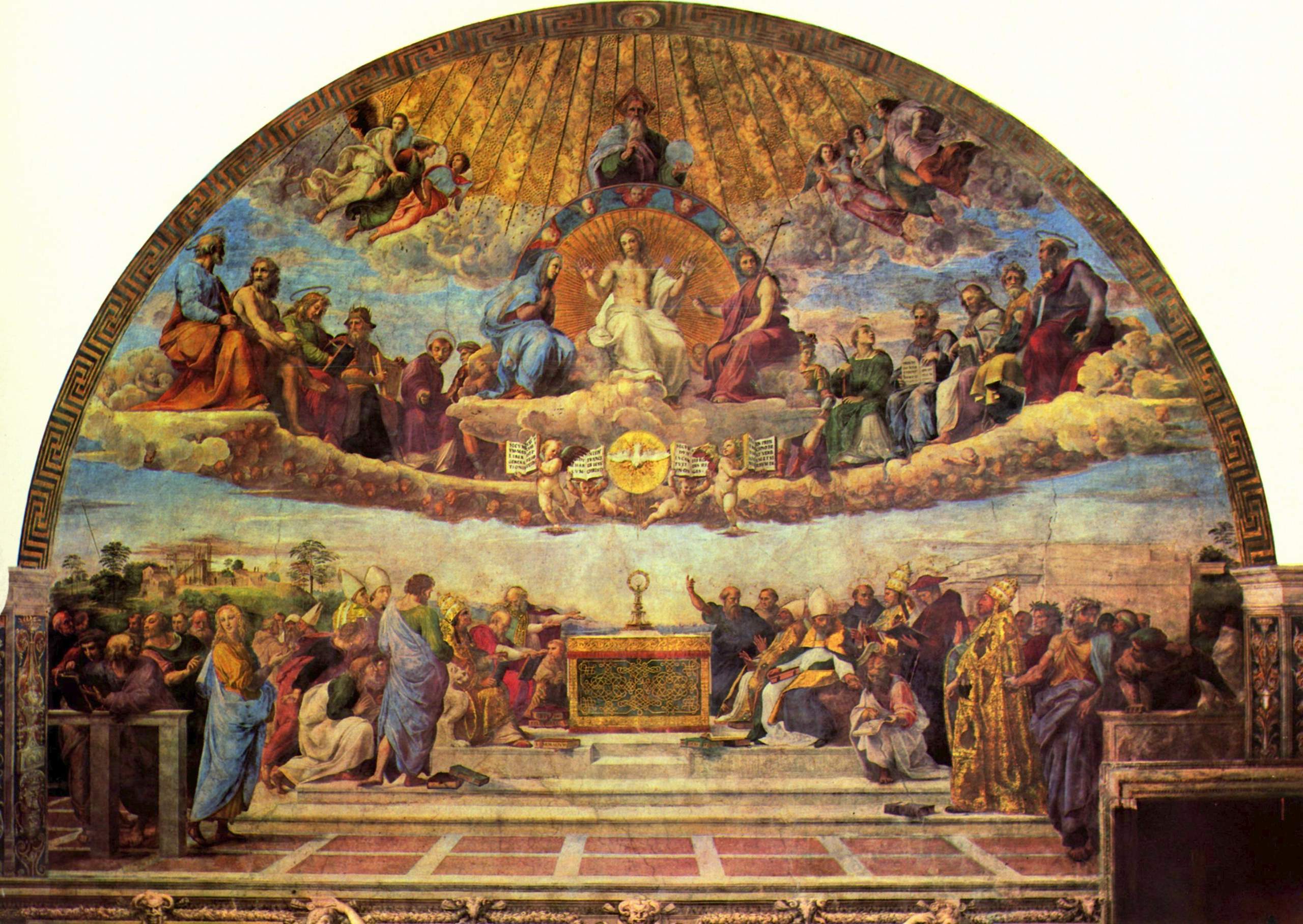
Father Boehner of the Franciscan Order pointed out, that the Frecos Stanza della Segnatura of Raphael was inspired by Franciscan thought, and that the textual source for it is the Prologue to Bonaventure's Breviloquium. In this series of frescos, we can see the Cardinal himself depicted, together with Pope Sixtus IV, who canonized him. (on the right side beneath, the one with the Cardinal's hat).

4) the natural and supernatural Beauty
Natural Beauty of the Soul: imago Dei - memoria, intellectus, voluntas - philosophical virtues; supernatural Beauty of the soul - theological virtues.
The Category of The Aesthetic in the Philosophy of Saint Bonaventure, by Sister Emma Jane Marie Spargo, St. Bonaventure, N.Y.: The Franciscan Institute, 1953.
This book, though quite good, is not such a splendid work like the Bonaventure book of our Holy Father. The author repeats too often the same ideas again and again, and doesn't develop many original insights. Nevertheless, some main ideas are quite interesting:
1) The optimism of Bonaventure and the positive attitude to the sensual world. Everything, that is, is beautiful and good. And the world is a book written by God, with his signature in it and hidden signs which could lead us to know God himself. This idea is not an uncommon one, nor is it new. The Irish theologian John Scot Eriugena already put forward a similar idea. That Bonaventure happened to concur with Eriugena, must be due to the Pseudo-Dionyius Areopagita renaissance in the thirteenth century, who inspired greatly Eriugena. In the system of Bonaventure, the transcendence is not totally separated from our sensual world. Instead, the world is a symbol of the thought of God before the creation, which was brought to actuality through the Son. The Divine Idea is hidden within the created world, which is actually an immense book written by God. And Bonaventure takes the Cosmos as a whole, quite in Platonic tradition. This can be seen in the Exemplarism of the Augustinian tradition. For Bonaventure there is a triune structure: Emantion - Exemplarism - Illumination The son emanates from the Father through a natural mode, the Divine wisdom knows everything, is the ground of knowledge. It is called light and mirror, and the book of life (Breviloquium I, 8, 2). It is the Exemplar of all creatures.
And the beauty of the Cosmos consists, not surprisingly, as the Platonics already teach, in the order and harmony between its parts. This idea is manifested in the Gothics of the 13th. century, in which Cathedrals were built according to a rational and systematic plan, and sculptures were cast as ideal of men and women, quite in contrast to the realism of the late medieval time. What is highly interesting is that 'beautiful' is taken by Bonaventure as a fourth transcendal (the other three being: unum, verum, bonum, as Kant in his Critique of Pure Reason still mentions). Transcendals are concepts which can be used to describe everything, which is. So the optism is really striking. I don't think the Platonic tradition teaches this doctrine. But Sister Spargo mentions Pseudo-Dinonysius Areopagite as the source of this thought. Nevertheless, some Franciscans already thought in this way, for example Thomas of York, Robert of Grosseteste, and John de la Rochelle.
In his Commentarium in libro Sententiarum St. Bonaventure says that "whatever possesses being will likewise possess a certain form, and everything that possesses form will possess beauty also as a necessary consequent following upon the form that gives it being" (p. 34). He refers to the etymology of the word formosa: Omne quod est ens, habet aliquam formam; omne autem quod habet aliquam formam, habet pulchritudinem (II 34, 2, 3, 6). Everything that is, is also good, and everything that is, is also beautiful. All good and all beauty have their source in the goodness of God: Omne bonum et pulchrum est a Deo bono; sed omnia visibilia bona sunt et pulcra (II 1, 1, 2, 1). The beauty is the proportion or harmony (congruentia), and there is an interior and an exterior beauty. This idea can be traced back to the Book of Wisdom: in the numero, pondere, mensura consist the habitudines. There are two trinities regarding the relation of one creature to another: one, taken from Dionysius: substantia, virtus et operation, the other is taken from Augustine: quo, constat, quo congruit, quo discernitur. For St. Bonaventure, as for St. Augustine, matter is not pure privation or potency, but contains the first and all prevading substantial form of light. According to St. Augustine matter has modum, speciem and ordinem. And beauty consists in order (II 9, unica, 6). The beauty and perfection of the universe result from unity.
Platonic concepts: the one, the true and the good, and to each of them there is a differnt kind of causality can be attributed (cf. p. 36):
the one - efficient causality
the good - final causality
the true - formal causality
And the beautiful embraces all these causes.
2) the rational structure of beauty: it is quite striking for Bonaventure. Not only does the rationality of beautiful consists in the above mentioned order and proportion, but also in the rational reflection which follows the delight which one experiences at the presence of what is beautiful. Beauty leads to love. The delight is experienced in the presence of the beautiful in a spontanious way and without reflection. Afterwards there follows an act of the intellect which inquires why these objects produce their pleasant effects and what constitutes the pleasure that result from their perception. (Hoc est autem cum quaeritur ratio pulchri, suavis et salubris; et invenitur, quod haec est proportio aequalitatis. Ratio autem aequalitatis est eadem in magnis et parvis nec extenditur dimensionibus nec succedit seu transit cum transeuntibus nec motibus alteratur). In this point St. Bonaventure differs from St. Thomas, the latter proposes that an element of grandeur is needed for an object to be considered beautiful. What makes the things beautiful is the beauty itself. Beauty, while it delights, does not fully satisfy, but leads one to seek further on, as Bonaventure wrote: "Scientia reddit opus pulcrum, voluntas reddit utile, persevarantia reddit stabile. Primum est in rationali, secundum in concupiscibili, tertium in irascibili" (De Red. Art. ad Theol. 13).
3) The Christo-centric theology of Bonaventure leads him to take scars as beautifying the body, it is also a Franciscan tradition as the Franciscans confide themselves to the Amor Pauperis Crucifixi. This Christo-centric theology is supposed by some researchers to be manifested in the depiction of Christ as the Creator, for example at the portal of Cathedral Chartres. At the entrance of Chartres Cathedral one can see: the Creator is not shown as an image of God the Father, but is Christ. There is another picture showing Christ as Creator (from a manuscript of the 13th. century):

Father Boehner of the Franciscan Order pointed out, that the Frecos Stanza della Segnatura of Raphael was inspired by Franciscan thought, and that the textual source for it is the Prologue to Bonaventure's Breviloquium. In this series of frescos, we can see the Cardinal himself depicted, together with Pope Sixtus IV, who canonized him. (on the right side beneath, the one with the Cardinal's hat).
4) the natural and supernatural Beauty
Natural Beauty of the Soul: imago Dei - memoria, intellectus, voluntas - philosophical virtues; supernatural Beauty of the soul - theological virtues.
Subscribe to:
Posts (Atom)
